
Teen Patti Online: Free Play, Real Money Options, Card Game Rules, and Winning Strategy Tips
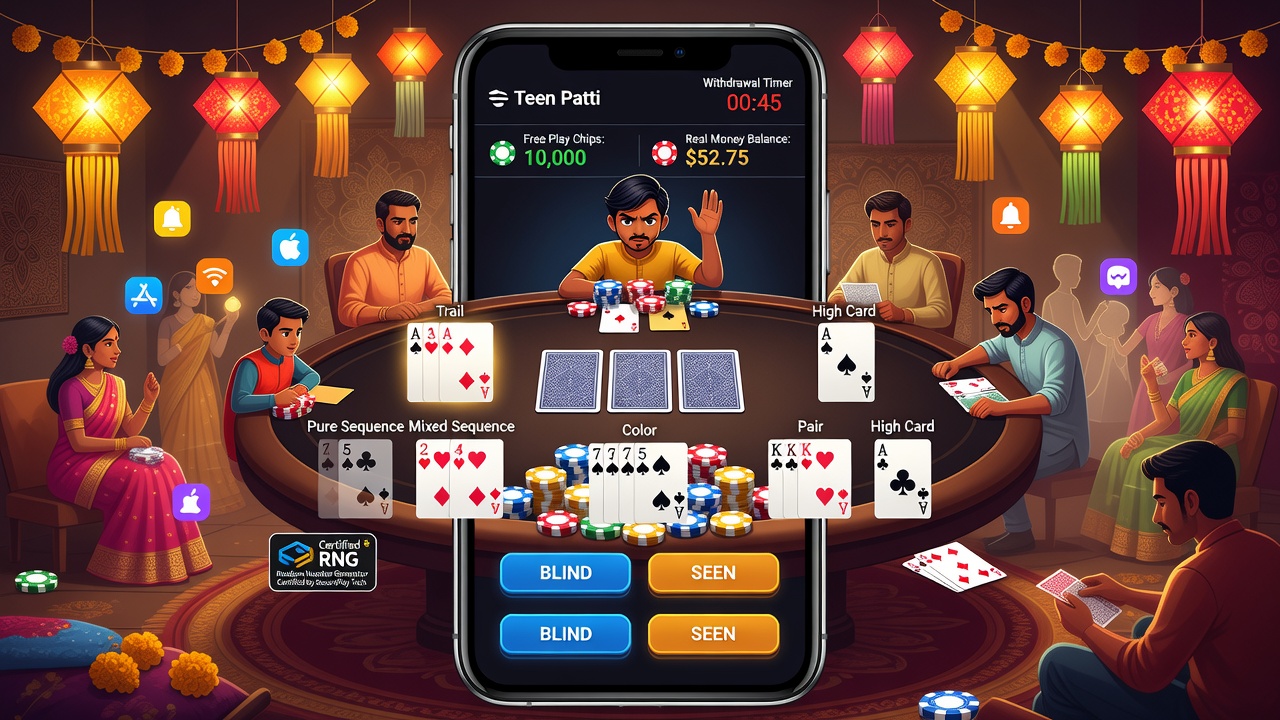
A standard deck holds 1,326 possible three-card combinations, and yet a game built entirely around that small number has become one of the most widely played card games across South Asia and beyond. Teen Patti has moved from living-room gatherings during festivals to smartphone screens, and the shift has changed almost nothing about the core appeal. The tension of a blind bet, the bluff that either pays off or collapses, the slow build of a pot - all of it survived the transition to digital tables intact.
What has changed is access. A Teen Patti online game no longer requires a physical deck, a group of friends with free evenings, or even a fixed location. Anyone with a phone can open an app and join a table within seconds, choosing between casual rounds and stakes that carry real financial weight. For players who want to test strategy without touching a wallet, platforms such as the teen patti game offer a practical entry point into how digital tables actually function before any money changes hands. That distinction - between play for enjoyment and play for profit - sits at the center of how the modern version of this game is structured.
This piece breaks down both sides of that divide. It covers how the rules translate to a screen, what separates free play from real-money tables, and which strategic habits actually hold up under pressure rather than just sounding clever in theory.
Understanding Teen Patti as a Card Game
Before touching a screen, it helps to understand what the game demands mentally. Teen Patti is not a game of pure chance dressed up with betting rounds - it rewards players who read situations correctly and punishes those who rely only on hope.
Origins and Cultural Context
Teen Patti developed as a social card game played primarily during festive gatherings, particularly around Diwali, where small-stakes betting among family and friends was as much about ritual as competition. Its structure borrows conceptually from poker but compresses the action into a tighter, faster format - three cards instead of five or seven, fewer betting rounds, quicker resolution. That compactness is precisely why it translates so well to mobile play.
How the Game Is Structured
Each player receives three cards face down. A pot builds through a boot amount contributed by everyone before the deal, and betting proceeds clockwise. Players choose to bet "blind," without looking at their cards, or "seen," after checking their hand - a choice with real strategic weight, since blind bets typically cost less and carry psychological signaling value.
Where Digital Play Diverges from Physical Play
Online tables remove some of the physical tells that experienced players rely on in person - hesitation, posture, the way someone stacks their chips. In exchange, digital versions introduce betting timers, visible pot histories, and pattern data across many hands that a live game never offers. Reading an opponent online means reading their betting rhythm rather than their face.
Teen Patti Card Game Rules Explained
Rules form the backbone of consistent play, and misunderstanding even one of them tends to cost players money faster than bad luck ever does.
Hand Rankings from Highest to Lowest
Knowing hand strength cold, without hesitation, is non-negotiable for anyone serious about the game.
- Trail or Set - three cards of the same rank, the strongest possible hand
- Pure Sequence - three consecutive cards of the same suit
- Sequence - three consecutive cards of mixed suits
- Color - three cards of the same suit, not in sequence
- Pair - two cards of matching rank
- High Card - no matching pattern, ranked by the highest card held
Betting Mechanics and Table Flow
Betting continues until all but one player folds or until a "show" is called between the final two remaining players, at which point hands are compared and the stronger one takes the pot. Side rules such as pot limits, maximum boot multiples, and specific variant packs (like AK47 or Muflis, where hand rankings invert) all shift strategy meaningfully, so checking table-specific rules before joining matters.
Common Rule Misunderstandings
New players frequently misjudge the value of a color hand versus a sequence, or assume a pair always beats a high card regardless of rank - both are true generally, but edge cases involving joker cards or wild-card variants can alter outcomes. Reading the specific rule set of a table before betting real money prevents avoidable losses.
Teen Patti Free Play: Practicing Without Risk
Free play exists for a reason beyond marketing - it is the only environment where mistakes are genuinely cost-free.
Why Free Tables Matter for Beginners
Teen Patti free play lets new players internalize hand rankings, betting sequences, and table etiquette without financial consequence. Muscle memory around when to fold a weak blind hand or when to raise pressure on an opponent develops faster through repetition than through reading strategy guides alone.
What Free Play Cannot Teach
The psychological weight of real stakes is absent in free tables. Players tend to bluff more recklessly and call more loosely when nothing tangible is on the line, which means behavior observed in free play doesn't always predict how the same player acts once money enters the equation.
Using Free Play as a Strategic Testing Ground
Experienced players still return to free tables to test unfamiliar tactics - an aggressive early-blind strategy, for instance - without risking bankroll. It functions less as entertainment and more as a low-cost laboratory for refining decision-making patterns.
Teen Patti Real Money: What Changes When Stakes Are Involved
Once actual currency is on the table, the game's psychological texture shifts entirely. Decisions that felt trivial in free play suddenly carry weight.
Bankroll Management Basics
Setting a fixed session limit before playing Teen Patti real money prevents the common trap of chasing losses. Serious players typically allocate a small, predetermined percentage of their total bankroll per session rather than committing large sums to a single unpredictable run.
Platform Verification and Fair Play
Legitimate platforms disclose licensing information, use certified random number generation for shuffling, and offer transparent withdrawal terms. Checking these details before depositing money is a basic safeguard, not an optional precaution.
Emotional Discipline Under Real Stakes
Tilt - the tendency to make increasingly reckless bets after a loss - affects real-money play far more than free play, precisely because losses register emotionally rather than abstractly. Recognizing the early signs of tilt and stepping away from a table is a skill that separates consistent players from those who bleed money steadily over time.
Teen Patti Strategy Tips That Actually Work
Strategy in Teen Patti is less about memorizing formulas and more about consistently applying a small set of disciplined habits.
Reading Betting Patterns
A player who raises aggressively while betting blind is often signaling confidence, but repeated aggressive blind betting from the same player over multiple hands can also indicate a deliberate pattern designed to intimidate opponents into folding strong hands. Tracking these tendencies across a session reveals far more than any single hand does.
Knowing When to Fold a Seen Hand
One of the most underused skills is folding a mediocre seen hand early rather than matching bets out of stubbornness. A pair of low cards rarely justifies staying in against sustained aggression from multiple opponents.
Position and Timing Advantages
Acting later in a betting round provides more information about opponents' confidence levels. Players in earlier positions carry more risk because they must commit before seeing how others react.
Bluffing With Purpose, Not Randomly
Effective bluffing depends on table history. A player who has shown strong hands consistently earns more credibility when bluffing later, because opponents are less likely to call a bet from someone who has demonstrated genuine strength before.
Choosing the Right Platform for Your Playstyle
Not every platform suits every kind of player, and matching personal goals to the right environment matters more than most players initially assume.
Casual Players Versus Competitive Players
Casual players benefit from platforms emphasizing free play and low-stakes tables, while competitive players gravitate toward sites offering tournament structures and higher-stakes real money formats with deeper strategic variance.
Mobile Versus Desktop Experience
Mobile interfaces prioritize speed and simplicity, which suits fast casual sessions, while desktop platforms often provide richer statistics and hand-history tracking that benefit players focused on long-term strategic improvement.
Frequently Asked Questions
Is Teen Patti purely luck, or does skill matter?
Card distribution is random, but decision-making around betting, folding, and bluffing is entirely skill-based. Over many hands, skilled players consistently outperform those who play reactively without strategy.
Can I switch between free play and real money on the same platform?
Most platforms allow players to move freely between free tables and real-money tables, often using separate virtual chip balances for each mode. This flexibility lets players warm up before committing actual funds.
What's the biggest mistake new players make with real money?
Overcommitting to weak hands after seeing cards, driven by the sunk cost of the boot amount already placed, causes the most avoidable losses. Folding early with a poor hand preserves bankroll far better than hoping for improvement.
How important are joker or wild-card variants?
Variants like Muflis or joker-included games change hand value hierarchies significantly, so reviewing the specific rule set before joining a table prevents costly misjudgments about hand strength.
Does playing on a phone put me at a disadvantage compared to desktop?
Not inherently - the core mechanics remain identical across devices. Desktop may offer more detailed statistics, but decision quality depends far more on strategic understanding than on device choice.
How can I tell if a real-money platform is trustworthy?
Check for clear licensing disclosures, certified random number generation for card shuffling, transparent withdrawal timelines, and visible customer support channels. Absence of these details is a warning sign worth taking seriously.