
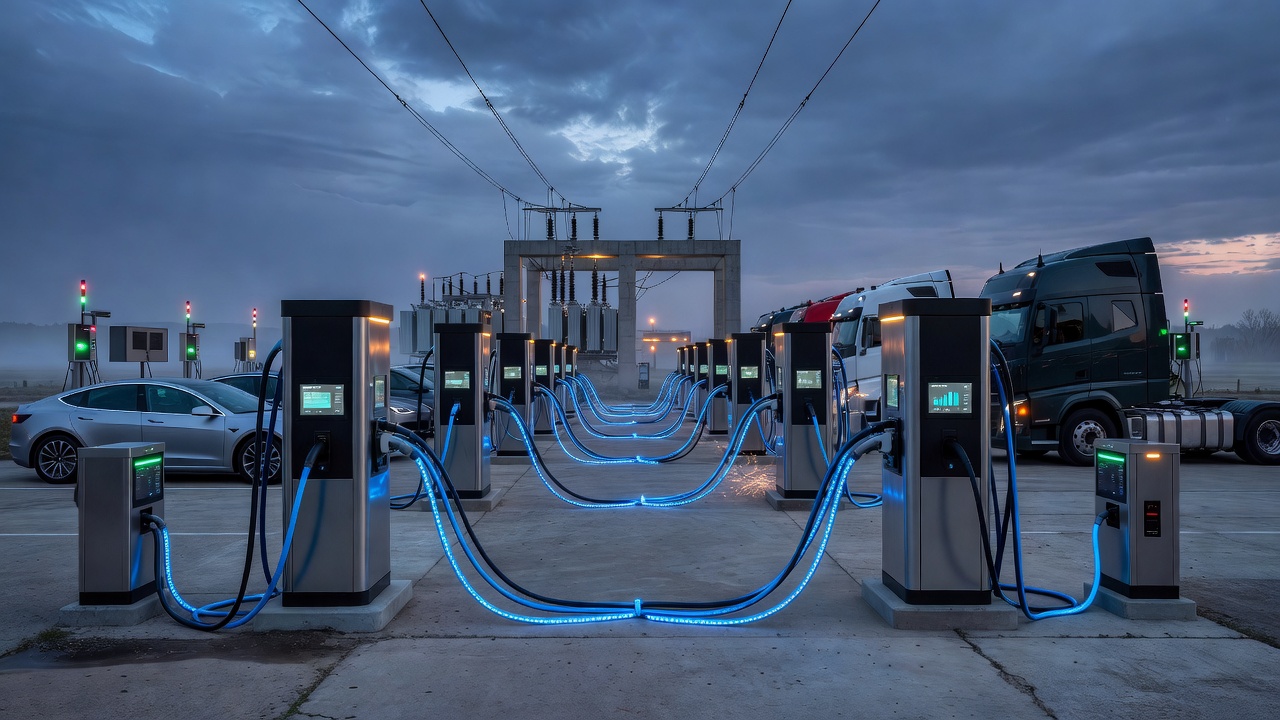
Kempower has introduced a charging dispenser designed to solve one of the thorniest infrastructure problems facing the electric vehicle transition: how to serve passenger cars and heavy-duty trucks without building two separate networks. The Finnish company's new Mega Satellite Flex supports both the established CCS standard, at up to 560 kW, and the emerging Megawatt Charging System, at up to 1.2 MW, from a single unit. It marks the first time Kempower has combined both standards in one dispenser, reflecting a broader industry shift as electric trucking moves from pilot projects toward commercial reality.
The timing matters. CCS has been the workhorse of fast charging for passenger EVs for years, but it was never engineered for the power demands of long-haul electric trucks, which need to recharge massive battery packs in the time it takes a driver to take a mandated rest break. MCS was developed specifically to close that gap, and its rollout is now gathering pace across North America and Europe. For readers trying to make sense of the surrounding jargon and the different charging tiers, resources like that guide can help clarify how these emerging standards compare to what most drivers already know from home and public charging.
One Site, Two Vehicle Classes
The practical appeal for site operators is straightforward: instead of building a car-only charging station now and a truck-only facility later, they can install infrastructure that handles both from the outset. Kempower says the Mega Satellite Flex integrates with its existing distributed charging architecture, meaning operators already running Kempower systems can add the new dispenser without reworking their power distribution or software. That compatibility lowers the cost and complexity of scaling a site as demand grows, rather than forcing a rebuild each time vehicle fleets diversify.
The unit is rated for up to 1,500 amps on the MCS side and 700 amps for CCS, with cable lengths of 5 meters for CCS and 2.7 meters for MCS. An optional payment terminal allows the same hardware to serve public, pay-per-use customers as well as fleet operators with dedicated accounts. Support for 800-volt vehicle architectures also future-proofs the investment somewhat, since newer passenger EVs and trucks built on higher-voltage platforms can draw power faster than older 400-volt systems allow.
Utilization Is the Real Battle
Charging hardware is only profitable if it is used often enough to justify the capital outlay, and high-power equipment is expensive to install and connect to the grid. A dispenser that can serve a passenger car in the morning and a delivery truck in the afternoon spreads that cost across more transactions per day, which is precisely the pitch Kempower is making to fleet operators and charge point owners. Idle hardware is the enemy of return on investment in this business, and flexible, dual-standard equipment is one of the clearer ways to address it without waiting for a second construction phase.
What Comes Next
Kempower unveiled the Mega Satellite Flex at its Unplug & Recharge event held alongside ACT Expo, a gathering focused on commercial vehicle electrification, where the unit is currently on display. The company expects to bring it to market in North America and Europe in July 2026, giving operators time to plan sites around a technology that is still being standardized across manufacturers and regions. As MCS adoption expands, dispensers capable of serving both current and next-generation trucks are likely to become a more common fixture at highway charging corridors and logistics hubs alike.